Claude Certified Developer Foundations - Ultimate Guide to the CCDV-F Exam
Why Model-Specific AI Certifications Matter in 2026
The AI landscape in 2026 has undergone a fundamental shift. General cloud-AI credentials, which once dominated the market by focusing on platform-level configurations, have been superseded by model-specific authority. As frontier labs like Anthropic deliver increasingly sophisticated reasoning capabilities, the value of a developer now rests on their ability to extract maximum performance from a specific model architecture. Model-specific certifications represent this transition, moving beyond basic infrastructure knowledge to validate deep mastery of the Claude ecosystem.
The Claude Certified Developer - Foundations (CCDV-F) is the premier foundational-level credential for this new era. Issued by Anthropic and delivered through proctored Pearson VUE environments, the CCDV-F is a high-stakes assessment that validates a developer’s ability to build, integrate, and ship production-grade applications, agents, and workflows. Unlike simple course-completion certificates, this proctored credential requires an objective demonstration of technical rigor. It marks the difference between a casual user and a professional engineer capable of navigating the nuances of the Claude platform. While the prestige of being “Anthropic Certified” is significant, the entry requirements are strictly calibrated for professional environments.
CCDV-F Exam Prerequisites and Target Audience
The CCDV-F is a professional-grade mandate designed for active builders, not prompt enthusiasts. Anthropic has structured this exam to filter for technical competence, ensuring that certificate holders can bridge the gap between raw LLM intelligence and hardened software systems. This is a builder’s exam; it ignores the “trivia” of chat interfaces to focus on API mechanics, SDK hierarchies, and agentic loops.
Successful candidates are typically engineers who translate high-level business requirements into functioning codebases. To meet the technical demands of the exam, candidates must be proficient in modern development patterns, including asynchronous programming and structured data management.
Candidate Profile
- Target Roles: AI/ML Engineers, Technical Leads, Senior Software Engineers, and Backend/Full-stack Developers.
- Recommended Experience: 1-5 years of professional software engineering; at least 6 months of hands-on development with Claude 4.5 or comparable frontier models.
- Technical Prerequisites: Proficiency in Python and/or TypeScript; fluency with REST APIs, JSON schema design, and asynchronous programming.
- Engineering Fluency: Deep familiarity with CLI tools and the Model Context Protocol (MCP) server-client architecture.
Claude Developer Exam Details: Cost, Format, and Registration
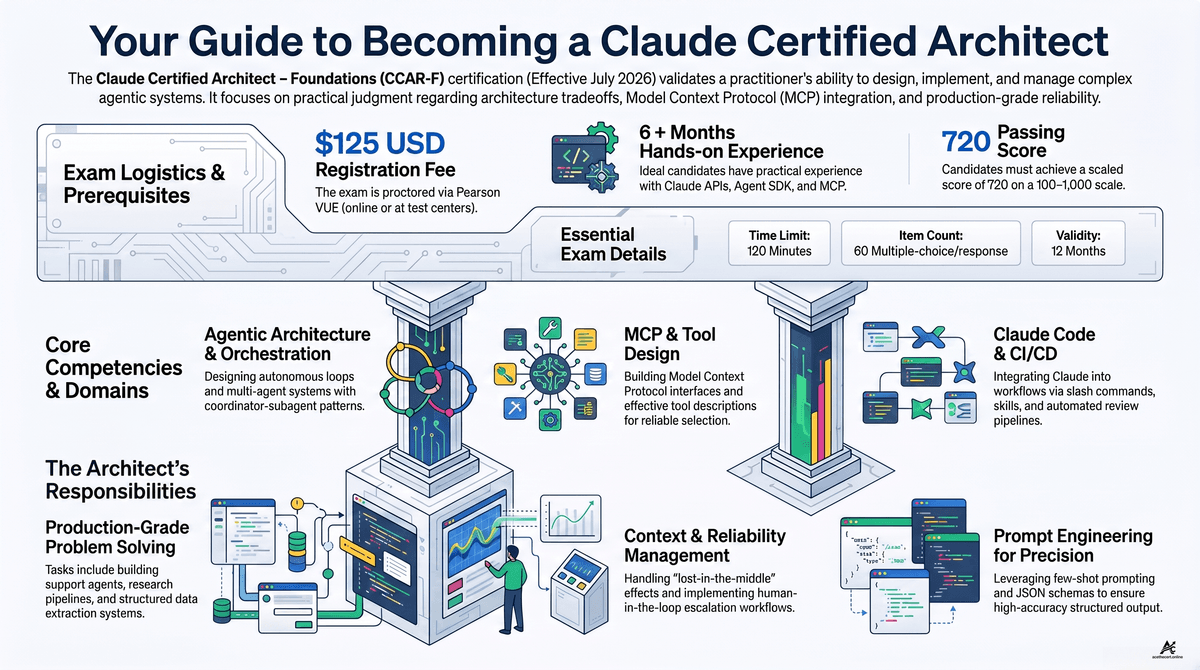
The CCDV-F maintains its market value through rigorous proctoring standards. Whether taken at a Pearson VUE test center or via secure online proctoring, the exam ensures a high bar of integrity. This is a paid professional assessment, distinct from the free educational tracks available in the Anthropic Academy. Note that registration is currently exclusive to the Claude Partner Network (CPN); candidates must register using a partner-associated email address to clear the registration gate.
CCDV-F Fast Facts
| Detail | Specification |
|---|---|
| Exam Fee | $125 USD (Partner-tier discounts apply) |
| Format | 53 Multiple-choice and Multiple-response items |
| Duration | 120 Minutes |
| Passing Score | Scaled score of 720 (Range: 100-1,000) |
| Language | English (with broader Pearson VUE support available) |
| Retake Policy | 14 days (1st fail), 30 days (2nd), 90 days (3rd); Max 4 attempts per 12 months |
CCDV-F Technical Blueprint: What You Need to Know
The CCDV-F blueprint is “unusually skewed,” specifically designed to prioritize the Application Integration layer where real-world production failures occur. It moves beyond theory, demanding that candidates understand how to manage the lifecycle of an AI-powered system.
The Eight Strategic Domains
- Applications and Integration (33.1%) - The exam’s heavyweight. This domain demands mastery of Claude API Mechanics (6.8%) including the Message Batches API and vision inputs, alongside Claude Application Design (8.6%) and Software Engineering Foundations (7.4%).
- Model Selection and Optimization (16.8%) - Candidates must evaluate trade-offs between Claude 4.5 Opus and Sonnet or the Haiku tier. This includes understanding “extended thinking” effort levels and prompt caching to manage cost/latency.
- Agents and Workflows (14.7%) - Focuses on the Claude Agent SDK, multi-agent orchestration, and manager/subagent hierarchies.
- Prompt and Context Engineering (11.0%) - Managing context window drift, output constraints, and structured data extraction.
- Tools and MCPs (10.6%) - Building custom tool schemas and Model Context Protocol (MCP) servers to bridge model capabilities with backend resources.
- Security and Safety (8.1%) - This represents a shift from “asking nicely” in prompts to using Claude Hooks (1.0%)-programmatic blocks that act as hard gates for destructive actions or sensitive data access.
- Claude Code (3.1%) - Operationalizing the CLI tool, managing Rules, Skills, Commands, and Agent Memory, and configuring the
CLAUDE.mdhierarchy. - Eval, Testing, and Debugging (2.6%) - Trace analysis and failure mode isolation between the integration layer and model output.
6-Week Study Plan to Pass the CCDV-F Exam
The CCDV-F is a scenario-based test of architectural and engineering judgment. You will not be asked to define terms; you will be asked to resolve production dilemmas within six specific authoritative scenarios: Customer Support, Code Generation, Multi-Agent Research, Developer Productivity, CI/CD, and Structured Data Extraction.
6-Week Study Roadmap
- Week 1: Foundations & Setup: Audit the Academy and download the v1.0 Exam Guide. Build a baseline “Hello World” using the Messages API.
- Week 2: Application Heavyweight (33.1%): Master the sub-skills of Domain 2. Focus on Claude Application Design and the Message Batches API for high-volume, latency-tolerant workloads.
- Week 3: Intelligence & Agents: Experiment with Claude 4.5’s extended thinking capabilities. Build a tool-use loop using the Claude Agent SDK.
- Week 4: Tools & MCP: Develop an MCP server. Practice defining typed arguments and permission checks for custom tools to ensure defensive parsing.
- Week 5: Security & Operations: Implement Claude Hooks for safety. Spend time in Claude Code, specifically mastering its “headless” mode for CI/CD integrations.
- Week 6: Review & Trace Analysis: Practice reading failure traces to isolate bugs. Redo the practice exam until you consistently hit a 900+ scaled score.
Career Benefits of Becoming Anthropic Certified
As the first frontier lab to offer a proctored model-specific program, Anthropic is setting the standard for AI ROI. The CCDV-F allows firms to distinguish a trained engineering team from generic AI positioning.
Lifecycle & Growth
- Validity: 12 Months. The rapid release cycle (e.g., Claude 4.5) necessitates annual validation.
- Renewal: Free on-time assessment via the Partner Academy if completed before the credential expires.
- Next Steps: Candidates should look toward the Claude Certified Architect - Professional (CCAR-P) for enterprise-scale governance and scaling leadership.
- Badging: Verified digital badges via Credly for LinkedIn and professional resumes.
5 Steps to Achieve Your CCDV-F Certification
- Secure Partner Network Access: Ensure your organization is registered in the Claude Partner Network (CPN) to unlock the Pearson VUE registration gate.
- Master the Academy & Docs: Complete the Developer track in the Academy, focusing on the delta between Sonnet and Opus 4.5.
- Build Implementation Evidence: Do not rely on documentation. Build a project that integrates custom tools and an MCP server. Treat your internal evaluations as a “release gate” to practice for the exam’s rigor.
- Register via Pearson VUE: Schedule your proctored session. Prepare to encounter scenarios involving CI/CD pipelines and Multi-Agent Research where you must isolate problems using failure traces.
- Claim your Credly Badge: Upon achieving a score of 720+, showcase your mastery. Use your knowledge of Claude Hooks and Agent Memory to lead high-stakes deployments.
The future of software is agentic. By mastering the Claude ecosystem now, you are not just passing a test-you are building the infrastructure for the next generation of intelligent applications.
Frequently Asked Questions
What roles are best suited for the CCDV-F certification?
What are the technical prerequisites for the CCDV-F?
What is the passing score and format for the CCDV-F?
Which domain is the most heavily weighted?
How do I register for the CCDV-F exam?
Ace The Cert Team
The official editorial team for Ace The Cert.
Related Posts

The Definitive Guide to the Claude Certified Architect Foundations
Discover everything you need to know about the Anthropic CCAR-F certification, including exam format, cost, preparation strategy, and the five core domains.

Claude Certified Associate Foundations - The Definitive Guide
Discover everything you need to know about the Anthropic CCAO-F certification. Learn exam costs, format, passing score, and how to prepare.

The Definitive Guide to the Claude Certified Architect Professional
Discover everything you need to know about the Anthropic CCAR-P certification, including exam format, cost, domains, and preparation strategies.
Comments are not configured for this site.