The Definitive Guide to the Claude Certified Architect Foundations
CCAR-F Introduction: The New Standard for Enterprise AI Engineering
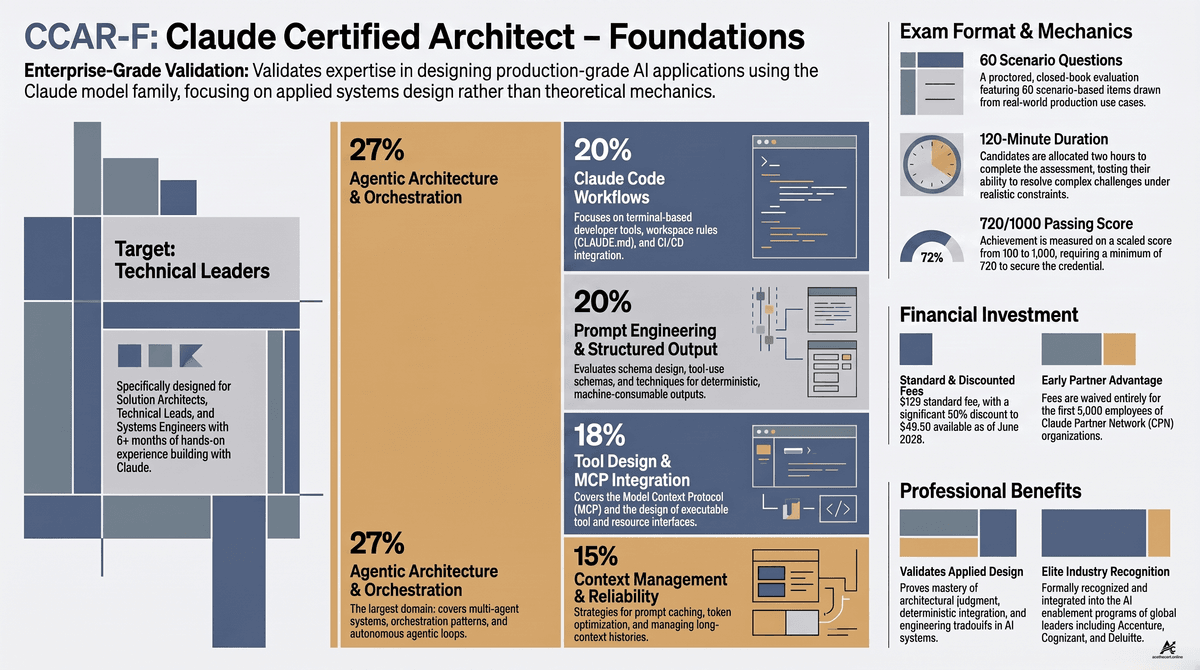
The Claude Certified Architect - Foundations (CCAR-F)-also designated as the CCA-F-represents the gateway technical credential in Anthropic’s professional ecosystem. As organizations transition from experimental chatbots to production-grade enterprise software, the CCAR-F serves as the definitive benchmark for validating an architect’s ability to design reliable, cost-effective, and scale-ready systems. Unlike theoretical certifications, this exam focuses strictly on applied systems design, engineering trade-offs, and the deterministic integration of the Claude model family into enterprise stacks.
To succeed, candidates must demonstrate mastery across five technical competency domains:
- Agentic Architecture & Orchestration: 27%
- Claude Code Configuration & Workflows: 20%
- Prompt Engineering & Structured Output: 20%
- Tool Design & MCP Integration: 18%
- Context Management & Reliability: 15%
Dive Deeper: CCAR-F Domain Quizzes and Study Guides
To fully prepare for the exam, dive into our domain-specific study guides and practice quizzes:
- Domain 1: Agentic Architecture & Orchestration
- Domain 2: Tool Design & MCP Integration
- Domain 3: Claude Code Configuration & Workflows
- Domain 4: Prompt Engineering & Structured Output
- Domain 5: Context Management & Reliability
Who is the Claude Certified Architect Foundations For?
The CCAR-F is engineered for practitioners who are hands-on with implementation and architectural decision-making. It is not a general AI literacy exam; it is a rigorous validation of technical proficiency.
Candidate Profile
- Target Roles: Solution Architects, Technical Leads, Senior AI/ML Engineers, and Systems Engineers.
- Recommended Experience: A minimum of 6+ months of hands-on experience building with Claude, including the Claude API and Model Context Protocol (MCP).
- Core Prerequisites: Proficiency in terminal-based development (Claude Code), API integration patterns, and the ability to design multi-agent topologies.
CCAR-F Exam Cost and the Claude Partner Network
The path to certification is closely tied to the Claude Partner Network (CPN), which provides specialized enablement for organizations deploying Claude commercially.
Quick Facts
- Standard Exam Fee: $125 USD (Pathways through specific registration portals may reflect $99 USD).
- Partner Waiver: The exam fee is waived for the first 5,000 employees of organizations registered in the Claude Partner Network.
- Registration Platform: Administered via Anthropic Academy and scheduled through the Skilljar/Pearson VUE portal.
- Partner Network Access: Joining the CPN is free and grants access to technical architects, sales playbooks, and the Anthropic Partner Academy.
CCAR-F Exam Format, Logistics, and Difficulty Level
The CCAR-F is a high-stakes, closed-book, proctored evaluation. No external documentation, AI assistants, or model interfaces are permitted during the session.
Exam Operational Parameters
| Parameter | Specification |
|---|---|
| Question Volume | 60 scenario-based items |
| Duration | 120 minutes |
| Delivery Format | Closed-book, proctored |
| Minimum Passing Score | 720 (Scaled score 100-1,000) |
| Retake Policy | 14 days after first attempt; 30 days after second |
The exam delivery engine randomly selects four extensive technical scenarios from a pool of six core archetypes. You must resolve challenges within these contexts:
- Customer Support Agent: Synchronous loops and programmatic escalations.
- Code Generation with Claude Code: Base-level rulesets and interactive tools.
- Multi-Agent Research System: Coordinator-subagent hierarchies and context isolation.
- Developer Productivity Assistant: Workspace management and tool-bounding.
- Claude Code for CI/CD: Headless execution and version-controlled rules.
- Structured Data Extraction: JSON-schema enforcement and Batch API optimization.
Global Access: Language Support and Testing Locations for CCAR-F
The exam supports a diverse global workforce with broad language and delivery options.
- Available Languages: English, Arabic, French Canadian, Korean, Japanese, and Simplified Chinese.
- Delivery Methods: Online proctoring is available via the OnVUE platform (Pearson VUE’s online system) or ProctorFree. Physical testing is also available at authorized Pearson VUE testing centers worldwide.
Key Skills Assessed in the Claude Certified Architect Foundations Exam
The CCAR-F evaluates your ability to function as a “state machine” orchestrator for AI agents.
Agentic Loops and State Management in Claude
Architects must manage the agentic lifecycle by inspecting the stop_reason returned by the API. Distinguishing between tool_use (requesting action) and end_turn (completion) is critical for driving the programmatic loop that appends tool results back into the conversation context.
Model Context Protocol (MCP) Integration for CCAR-F
Candidates are assessed on their ability to decouple computational services via MCP. This includes configuring MCP servers, managing primitives (Tools, Resources, Prompts), and optimizing transport layers such as stdio or Stream-Based Server-Sent Events (SSE).
Claude Code and CLI Configuration Mastery
Assessment focuses on the hierarchy of configuration tiers:
- User Scope: Globally stored in
~/.claude.json. - Project Scope: Shared via version control in
.mcp.json. - Directory Scope: Localized overrides for specific folder behaviors.
Prompt Prefilling and Structured Output Techniques
To enforce syntactic compliance, architects use Prompt Prefilling. By pre-populating the initial assistant response with an opening curly brace {, you constrain the model to output valid JSON. This is paired with tool-use schemas to ensure outputs are machine-consumable.
Architecting with Integrity: AI Safety and Best Practices
Safety is treated as an engineering constraint, not an afterthought. The curriculum emphasizes the Helpful, Harmless, and Honest (HHH) trio of Constitutional AI.
The Safety Blueprint A core architectural requirement is the implementation of deterministic validation gates. Because LLM self-confidence scores are notoriously “poorly calibrated,” architects must use Pydantic or JSON Schema for semantic validation. If a line-item total does not match an invoice total, the system must trigger a programmatic retry or escalation rather than trusting the model’s self-assessment.
Comprehensive Preparation Strategy for the CCAR-F Exam
Estimated study time for experienced Claude developers is 15-20 hours, while newcomers should budget 30-40 hours.
6-Week Preparation Blueprint
- Week 1: API Foundations (Level 100): Complete AI Fluency (1.5 hrs) and Building with the Claude API (8+ hrs). Master core prompt structures and the agentic loop.
- Week 2: Local Environments (Level 200): Complete Claude Code in Action (1 hr). Configure
CLAUDE.mdand test directory scoping. - Week 3: MCP Design (Level 200): Complete Intro to MCP (10 min) and Advanced MCP (1 hr). Build a functional server using
stdio. - Week 4: Cost & Scaling: Master the Message Batches API. Understand that it offers a 50% cost discount in exchange for a 24-hour latency window.
- Week 5: Multi-Agent Topologies: Design hub-and-spoke systems. Ensure subagents are isolated; the coordinator must explicitly inject metadata into their prompts.
- Week 6: Practice & Review: Use mock assessments to target an 85% success rate before the proctored session.
Career Value and Job Roles for a Claude Certified Architect
The CCAR-F is a high-trust signal in a market where technical AI competence is rare.
- Job Roles Post-Certification: Solutions Architect, Systems Administrator, IT Specialist, and Technology Professional.
- Career Benefits: For roles such as Systems Administrator or IT Specialist, the average salary range is $70,000 to $110,000.
- Industry Recognition: The credential is recognized by global leaders including Accenture, Deloitte, Cognizant, and Infosys.
Maintaining Your Certification: CCAR-F Expiration and Renewals
The Claude ecosystem evolves rapidly, requiring frequent re-validation of skills.
- Validity: The certification is valid for 12 months. Annual renewal is required to maintain professional standing.
- Next Tier: The Claude Certified Architect - Professional (CCAR-P) is the advanced tier, focusing on enterprise-scale security, governance, and complex multi-agent scaling.
Step-by-Step Guide to Getting Your Claude Architecture Certification
- Register for the CPN: Join the Claude Partner Network to access training and fee waivers.
- Complete the Academy: Finish the Level 100 and 200 curricula on the Anthropic Academy/Skilljar platform.
- Build Hands-On: Deploy a multi-agent system using a centralized coordinator and isolated subagents.
- Schedule the Exam: Register via the Skilljar portal. Note the 14-day retake regulation if you do not pass on the first attempt.
- Claim Your Badge: Verified earners receive a digital badge via Credly for display on LinkedIn.
Conclusion: Is the Claude Certified Architect Foundations Worth It?
The Claude Certified Architect - Foundations is an investment in technical authority. By mandating a closed-book, proctored environment, Anthropic has created a certification that filters for genuine engineering talent. For architects looking to lead the next generation of agentic enterprise systems, this credential is the essential first step.
Frequently Asked Questions
What is the target audience for the CCAR-F certification?
How many domains are tested on the CCAR-F exam?
Is coding experience required for the CCAR-F?
How much does the CCAR-F exam cost?
What is the passing score and exam format?
Ace The Cert Team
The official editorial team for Ace The Cert.
Related Posts

Claude Certified Associate Foundations - The Definitive Guide
Discover everything you need to know about the Anthropic CCAO-F certification. Learn exam costs, format, passing score, and how to prepare.

The Definitive Guide to the Claude Certified Architect Professional
Discover everything you need to know about the Anthropic CCAR-P certification, including exam format, cost, domains, and preparation strategies.
Claude Certified Developer Foundations - Ultimate Guide to the CCDV-F Exam
A comprehensive guide to passing the Anthropic Claude Certified Developer Foundations (CCDV-F) exam, including prerequisites, exam details, and a 6-week study plan.
Comments are not configured for this site.