The Definitive Guide to the Claude Certified Architect Professional
What is the CCAR-P Certification? Enterprise AI Architecture Explained
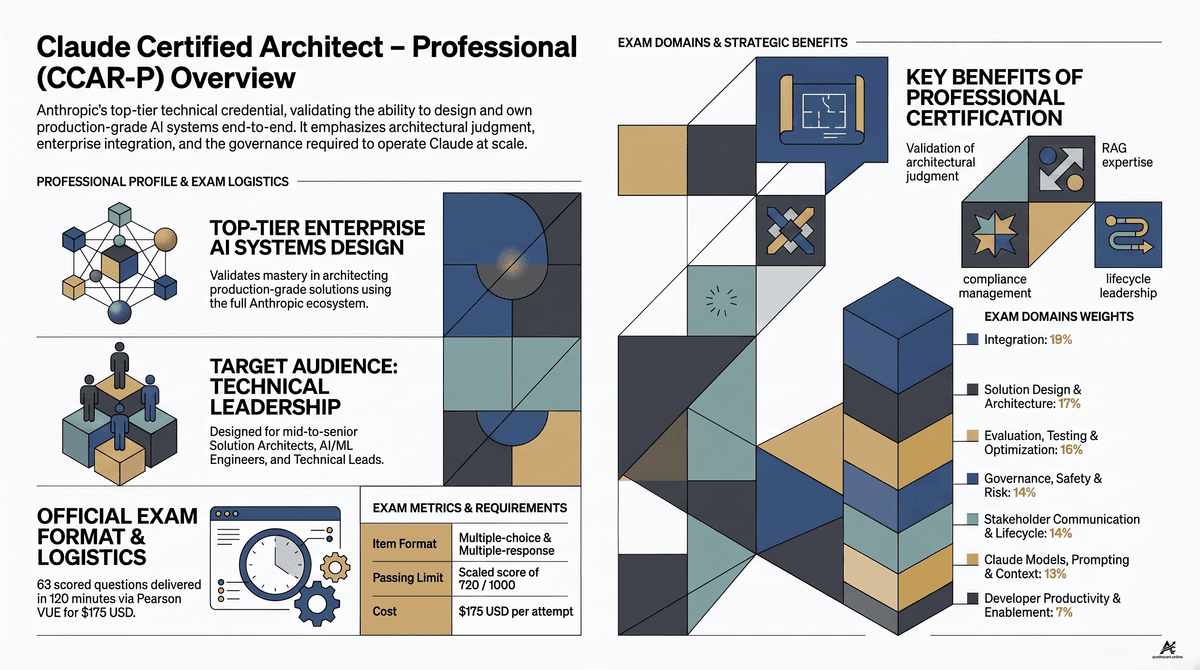
As enterprise AI matures beyond isolated experiments, the role of the architect has shifted from understanding model capabilities to exercising “Architectural Judgment.” Moving a solution into a high-stakes production environment requires a strategic mastery of trade-offs, scalability, and long-term reliability that foundational knowledge cannot provide. The Claude Certified Architect - Professional (CCAR-P) is the definitive credential for those tasked with de-risking the AI journey. It validates a professional’s ability to navigate the full technical lifecycle: Discovery, Design, Handoff, Monitoring, and Iteration.
While foundational understanding focuses on what the technology is, the CCAR-P demands an assessment of how the technology behaves under pressure. Architects must move beyond “prompt engineering” to “Context Engineering,” making high-impact decisions regarding model tiers, pattern selection, and security postures. This certification serves as the industry benchmark for professionals who can translate complex business challenges into resilient, production-grade solutions.
CCAR-P Target Audience: Is This Certification Right for You?
In a landscape increasingly populated by autonomous agents, human expertise remains the primary safeguard against “capability bloat” and ethical drift. The architect acts as the essential navigator, steering through technical trade-offs where cost, latency, and accuracy are in direct conflict.
The CCAR-P is designed for seasoned technical leaders, including Solutions Architects, Cloud Engineers, and AI Strategy Consultants. Notably, the Claude Certified Architect - Foundations (CCA-F) is not a formal prerequisite; the CCAR-P is a standalone track. However, the level of architectural judgment required is significantly higher than the foundational tier.
Regarding technical proficiency, “Coding Knowledge” at the Professional level is defined as Configuration as Architecture. Architects are not expected to write boilerplate code, but they must enforce standards across the developer workflow. This includes managing the hierarchy of configuration using CLAUDE.md (User vs. Project vs. Directory scopes) and utilizing path-scoping with YAML frontmatter to govern project rules. By mastering these configuration mechanisms, the architect ensures that AI-assisted development remains consistent across the entire team.
CCAR-P Exam Format, Cost, and Passing Score
In a rapidly evolving technical landscape, standardized assessment is the only way to maintain technical integrity. The CCAR-P exam provides a rigorous environment to ensure that certified professionals meet global standards of excellence.
Exam Quick Facts
| Feature | Detail |
|---|---|
| Duration | 120 Minutes |
| Cost | $175 USD |
| Total Scored Questions | 63 Questions |
| Passing Score | 720 / 1000 (Scaled) |
| Delivery Format | Pearson VUE Test Center or Online Proctored |
| Registration | Anthropic Partner Academy |
Candidates must be aware of the “No Partial Credit” rule for multiple-response questions. To earn points, every selected option must be defensible and correct; selecting a single “plausible but wrong” answer nullifies the entire response. This requires a strategy of absolute certainty and a deep understanding of trade-offs rather than rote memorization.
CCAR-P Syllabus Breakdown: The Seven Core Domains
Designing robust AI systems requires a multi-domain approach that balances business value with technical constraints. The CCAR-P exam evaluates candidates across seven pillars:
| Domain | Weight | Core Focus |
|---|---|---|
| 1. Solution Design & Architecture | 17% | Pattern selection; decomposition; business alignment. |
| 2. Models, Prompting & Context | 13% | Model tiers; prompt techniques; caching strategies. |
| 3. Integration | 19% | MCP; RAG; Auth; tool scoping (Heaviest Domain). |
| 4. Evaluation, Testing & Optimization | 16% | Metrics; eval datasets; failure diagnosis. |
| 5. Governance, Safety & Risk | 14% | Guardrail layers; HITL; compliance frameworks. |
| 6. Stakeholder Communication | 14% | Discovery; SLAs; Architecture Decision Records (ADRs). |
| 7. Developer Productivity | 7% | Claude Code; team configuration; operations. |
The Integration domain is the heaviest weighted section (19%) because it represents the primary hurdle for enterprise architects: connecting the model to the “real world.” Mastery of the Model Context Protocol (MCP) and complex Retrieval-Augmented Generation (RAG) pipelines is central to providing utility beyond a simple chat interface. To test your knowledge, try the Domain 1 Quiz, Domain 2 Quiz, Domain 3 Quiz, Domain 4 Quiz, Domain 5 Quiz, Domain 6 Quiz, and Domain 7 Quiz.
Key Technical Skills Assessed on the CCAR-P Exam
The professional architect must prioritize architectural pattern selection over simple model interaction. Candidates are assessed on their ability to apply Pattern Selection Rules:
- Augmented LLM: Default to this when a single, well-scoped model call with tools solves the task at the lowest cost.
- Workflow: Choose this for known, fixed sequences where predictability and auditability are paramount.
- Agentic: Reserved for open-ended discovery where the path cannot be scripted upfront.
A critical insight for the professional level is the Re-ranking trigger: Architects must mandate a re-ranker when first-stage retrieval shows high recall but low precision. This ensures only the most relevant chunks reach the prompt, preventing “context stuffing.”
Furthermore, architects must master Prompt Caching to manage latency and cost. You must avoid the three classic cache-breaking mistakes: placing a timestamp or User ID early in the system prompt, reordering tool definitions between calls, or shuffling the order of reference documents. The professional standard is to structure prompts “stable-content first, variable-content last.”
Governance, Safety & Compliance: Core Architect Responsibilities
The architect is the ultimate gatekeeper of enterprise risk. The CCAR-P requires a defense-in-depth strategy involving five specific guardrail layers:
- Input Validation: Injection screening before the model is reached.
- System Prompt Constraints: Explicit boundaries on behavior.
- Tool Scoping: Limiting agent permissions to the absolute minimum (Least Privilege).
- Output Filtering: Programmatic moderation before the response reaches the user.
- Human Review: The final layer for flagged or high-stakes results.
Human-in-the-Loop (HITL) placement is risk-based: it is mandatory for irreversible actions (e.g., payments, data deletion) and regulated tasks, while routine volumes should use sampling. Additionally, architects must spot compliance triggers on sight:
- GDPR: Triggered by processing personal data of EU residents.
- HIPAA: Triggered by handling Protected Health Information (PHI) for US covered entities.
- FedRAMP: Triggered by cloud services for US federal agencies.
CCAR-P Salary Expectations and Career Value
The market premium for verifiable AI expertise is substantial. As organizations move from “shadow AI” to governed infrastructure, they require architects who can build systems that don’t just work, but comply.
Data indicates that top-tier AI and cloud certifications correlate with compensation exceeding $150,000 per year. The value of the CCAR-P lies in your ability to “de-risk” the enterprise-moving beyond hobbyist bots to systems that respect SLAs and governance frameworks. Large enterprises and government agencies specifically value the CCAR-P for its international recognition and focus on the full solution lifecycle.
CCAR-P Study Guide and Preparation Strategies
Success requires a structured study plan to avoid the “Flagship-Everywhere” fallacy-the error of recommending the most expensive model tier for tasks that a faster, cheaper tier like Haiku could solve.
Essential Resources:
- Anthropic Official Documentation: The primary source for API, MCP, and Claude Code specifics.
- Tutorials Dojo Practice Exams: The gold standard for mastering the “No Partial Credit” format.
- Architecture Decision Records (ADRs): Study these as the primary mechanism for preserving architectural reasoning within a team.
A typical preparation timeline is six weeks. This allows for a deep dive into integration patterns and hands-on experience with the Claude Agent SDK and MCP.
CCAR-P Certification Renewal and Digital Badge
In the tech sector, knowledge has a short half-life. To ensure the CCAR-P remains a credible signal of current expertise, it is valid for 1 year.
Anthropic provides a streamlined “Free Renewal” process. Before expiration, professionals can complete a non-proctored assessment to maintain their status. Once certified, architects can showcase digital badges on LinkedIn to attract recruiters. This metadata-rich credential allows top-tier firms to verify your skills as a leader in AI architectural design.
Step-by-Step Roadmap to Becoming a Claude Certified Architect Professional
- Request Access: Log in to the Anthropic Partner Academy and register for the CCAR-P track.
- Study the Seven Pillars: Prioritize your time based on the domain weights, focusing heavily on Integration (19%).
- Master Integration Patterns: Gain hands-on experience with the Claude Agent SDK, MCP, and Agent-to-Agent Delegation.
- Practice Testing: Use professional-grade practice exams to refine your decision-making logic and avoid trap answers.
- Pearson VUE Exam: Schedule your proctored session (online or in-center).
- Architectural Leadership: Claim your badge and lead the transition to production-grade AI.
The shift toward the AI-driven enterprise is an architectural challenge, not just a coding one. By pursuing the CCAR-P, you position yourself as a leader capable of building the next generation of scalable, safe, and efficient AI systems. Take the first step toward architectural mastery today.
Frequently Asked Questions
How does the CCAR-P differ from the CCAR-F?
Is the CCAR-F a prerequisite for the CCAR-P?
What is the format of the CCAR-P exam?
Which exam domain carries the most weight?
How long is the CCAR-P certification valid?
Ace The Cert Team
The official editorial team for Ace The Cert.
Related Posts

The Definitive Guide to the Claude Certified Architect Foundations
Discover everything you need to know about the Anthropic CCAR-F certification, including exam format, cost, preparation strategy, and the five core domains.

Claude Certified Associate Foundations - The Definitive Guide
Discover everything you need to know about the Anthropic CCAO-F certification. Learn exam costs, format, passing score, and how to prepare.
Claude Certified Developer Foundations - Ultimate Guide to the CCDV-F Exam
A comprehensive guide to passing the Anthropic Claude Certified Developer Foundations (CCDV-F) exam, including prerequisites, exam details, and a 6-week study plan.
Comments are not configured for this site.