The Ultimate Guide to ITIL 5 Foundation: Master the Future of Digital Product Management
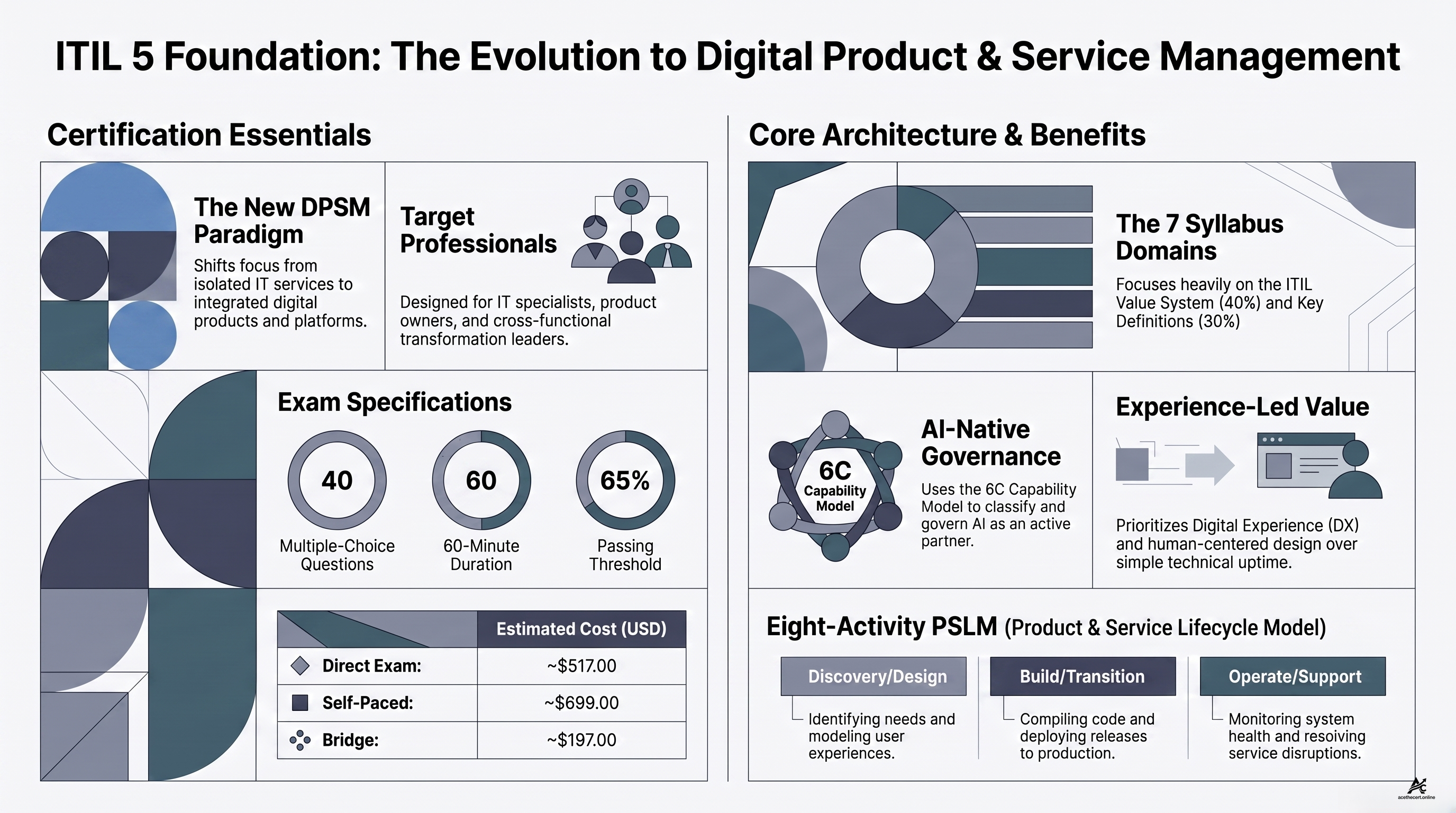
The release of ITIL 5 in early 2026 represents the most significant evolution in the framework’s 40-year history. We have moved beyond the era of traditional IT Service Management (ITSM) into a new paradigm: Digital Product and Service Management (DPSM).
As your mentor and curriculum strategist, I am here to guide you through this shift. ITIL 5 is not simply an update; it is the “operating system” for Industry 5.0, designed to unify human-centricity, organizational resilience, and AI-native design into a single, fluid architecture.
1. The Paradigm Shift: What is ITIL 5?
The core of ITIL 5 is the recognition that technology is no longer a “support function”—it is the product. This version addresses the “Governance Crisis” of the modern era, where 90% of organizations use AI but only 18% have a mature framework to manage it.
To master the foundational vocabulary, dive into our dedicated study guide on ITIL 5 Key Terms and Definitions.
This shift rests on three core pillars:
- Industry 5.0 Alignment: A focus on human-centricity and resilience, ensuring technology serves societal and organizational sustainability.
- AI-Native Design: AI is no longer an “add-on” but a core partner in value streams, requiring embedded governance from day one. See our deep-dive on AI-Native Design in ITIL 5.
- The PSLM Transition: The linear Service Value Chain of ITIL 4 has been replaced by the fluid Product and Service Lifecycle Model (PSLM) to eliminate the traditional handoff silos between development and operations.
Traditional ITIL 4 (Service-Centric) vs. Modern ITIL 5 (Product-Centric)
| Feature | ITIL 4 | ITIL 5 |
|---|---|---|
| Primary Goal | Service Management (ITSM) | Digital Product & Service Management (DPSM) |
| Core Model | Service Value Chain (Linear) | Product & Service Lifecycle Model (Fluid) |
| AI Role | Passive/Emerging | AI-Native/Embedded Partner |
| Philosophy | Value Co-creation | Resilience & Human-Centricity |
| Practices | 3 Categories (incl. Technical) | 2 Simplified Categories (Technical removed) |
To manage these digital products, you must first master the holistic dimensions that prevent operational bottlenecks.
2. The Structural Blueprint: Dimensions and Lifecycles
In the world of a Senior Architect, we do not view “People” or “Technology” in isolation. We view them as a holistic system.
The Four Dimensions
These dimensions must be addressed concurrently. Failure in one creates a systemic vulnerability in the product. For a complete breakdown, explore our guide on the Four Dimensions of Service Management.
- Organizations and People: Beyond roles, this focuses on corporate culture and the transition of teams from operating tools to collaborating with AI agents.
- Information and Technology: Encompasses data models, observability systems, and the 6C AI Model.
- Partners and Suppliers: Managing the complex web of SaaS, cloud providers, and the PESTLE factors (Political, Economic, Social, Technological, Legal, Environmental) that affect them.
- Value Streams and Processes: Coordinating the flow of work to optimize lead times and eliminate waste.
The 8 Activities of the Product and Service Lifecycle Model (PSLM)
The PSLM provides “stepping stones” for agile delivery. By integrating these activities, we eliminate the friction between creation and support. Study the complete lifecycle in our PSLM and Product & Service Offering guide.
- Discover: So What? We verify feasibility and customer demand before wasting capital on unviable ideas.
- Design: So What? We model the user experience and service parameters to ensure the product is “fit for purpose.”
- Acquire: So What? We secure the necessary cloud infrastructure and software licenses to build the foundation.
- Build: So What? We compile code and package releases in a way that ensures they are ready for the live environment.
- Transition: So What? We deploy releases while ensuring systems are observable, reducing the risk of “dark” failures.
- Operate: So What? We use Site Reliability Engineering (SRE) to maintain system health and meet availability targets.
- Deliver: So What? This is the moment of truth where we co-create value through the actual use of the product.
- Support: So What? We resolve incidents and gather feedback to drive the next cycle of the “Discover” phase.
To see how the ITIL Value System orchestrates all these components, refer to our ITIL Value System study guide.
As digital landscapes become increasingly automated, these dimensions are now governed by a powerful new entity: Artificial Intelligence.
3. AI-Native by Design: Governance and the 6C Model
Traditional IT governance fails where AI succeeds because AI is probabilistic, not deterministic. ITIL 5 addresses this “Governance Crisis” by emphasizing that AI governance is a leadership challenge, not a technology one. If you retrofit governance after deployment, it will cost you 6 to 8 times more than upfront investment.
The 6C AI Capability Model
Use this model to classify what your AI actually does within the “Information and Technology” dimension. Master these concepts in our AI-Native Design domain guide.
| Capability | Functional Role | Real-World Example |
|---|---|---|
| Creation | Generating content | Drafting incident summaries or service contracts. |
| Curation | Filtering information | Alert correlation and deduplication to reduce “noise.” |
| Clarification | Simplifying complexity | Translating technical log data into plain language. |
| Cognition | Predicting and deciding | Predicting incident severity or resource capacity. |
| Communication | Interacting with humans | Virtual assistants using natural language processing. |
| Coordination | Orchestrating workflows | Automatically routing tickets or triggering rollbacks. |
The ITIL AI Governance Framework
To ensure trust, we apply four perspectives and utilize a likelihood x impact risk matrix across four governance patterns (such as Stewardship and Control):
- Decision Authority: Defining who—or what—is authorized to approve automated actions.
- Ethics: Implementing procedures to mitigate algorithmic bias and ensure fairness.
- Data Governance: Regulating training data quality to prevent model drift.
- Regulatory Compliance: Aligning with frameworks like the EU AI Act or Singapore’s Model AI Governance.
4. The ITIL 5 Foundation Exam: Technical Breakdown
To prove your mastery, you must clear the official exam. Do not be intimidated: it requires absolutely no coding.
The exam targets Bloom’s Level 1 and 2.
- Level 1 (Recall): Can you remember the definition of “Value”?
- Level 2 (Understanding): Can you explain how a Guiding Principle interacts with a Value Stream?
Quick Facts
- Exam Code: ITILFNDV5
- Format: Closed book, 40 Multiple-Choice Questions.
- Duration: 60 Minutes (75 for non-native speakers).
- Passing Score: 65% (26/40).
- Languages: Available in 9 languages, including English, French, German, Spanish, Italian, Chinese, Japanese, Portuguese, and Brazilian Portuguese.
Crucial Update: In ITIL 5, the “Technical Management” practice category has been removed. Key practices like Deployment Management have been moved into the “Product and Service” category to align with the PSLM.
For practical application of these exam concepts, test yourself with our Value Stream Identification quiz.
5. Investment and Preparation: Costs and Resources
Earning this credential is an investment in your professional capital. While the syllabus is free, the PeopleCert ecosystem requires a paid voucher.
- Exam Voucher: ~$517 (This usually includes the Official eBook, which is the definitive reference text and mandatory for passing).
- Self-paced Training: $400 – $800 (Includes videos and practice banks).
- Live Virtual Bundles: $1,995 – $2,600+ (Expert-led with “pass guarantees”).
Study Recommendation: Plan for 40 to 60 hours of study over 4 weeks. Do not book your exam until you score 85%+ on mock exams.
6. Career Impact: Is It Worth It?
As your mentor, I can tell you: ITIL is the “global lingua franca” of business technology. It has expanded into Enterprise Service Management (ESM), meaning your skills are now applicable in HR, Facilities, and Finance—not just the data center.
Career Pathways
- Target Roles: Product Owner, IT Delivery Manager, Experience Manager, Service Architect, and Transformation Lead.
- Market Value: In 2026, being “ITIL 5 Certified” signals you can manage the high-risk, high-reward intersection of AI and human-centric products.
7. Your Path to Success: A Step-by-Step Roadmap
- Acquire the Syllabus: Every question is mapped to a learning outcome here.
- The Reference Text: Read the Official eBook cover-to-cover. It is the only authority on the 6C Model and PSLM.
- Training & Self-Study: Dedicate 10-12 hours per week for one month.
- Mock Exams: Practice the four question types (Standard, Negative, Missing Word, List-based). Start with our Framework Integration practice quiz.
- Proctored Exam: Pass and claim your Digital Badge. Note: You must renew every 3 years or maintain CPD points.
8. Beyond Foundation: The Certification Scheme
The Foundation level is your entry point. The scheme offers advanced designations for your long-term career architecture. A vital change in ITIL 5 is the ITIL Transformation module—a “universal requirement” that serves as the bridge for all advanced streams.
| Designation | Target Professional Profile |
|---|---|
| ITIL Practice Manager (PM) | Operational supervisors and process improvement leads. |
| ITIL Managing Professional (MP) | Product owners and delivery leads managing end-to-end lifecycles. |
| ITIL Strategic Leader (SL) | CIOs and Architects driving digital transformation. |
| ITIL Master | The ultimate tier for Senior Directors and Executive Consultants. |
In the age of Industry 5.0, your ability to govern AI while maintaining human-centric value is your greatest competitive advantage. Welcome to the future of digital management.
Explore All ITIL 5 Foundation Domains
Ready to test your knowledge? Dive into our interactive quizzes for each domain:
- Domain 1: Key ITIL Terms and Definitions — Master the foundational vocabulary of DPSM, value co-creation, and service relationships.
- Domain 2: The Four Dimensions — Understand the holistic perspectives of Organizations & People, Information & Technology, Partners & Suppliers, and Value Streams.
- Domain 3: Product and Service Offering — Explore the PSLM activities and how products and services are configured.
- Domain 4: The ITIL Value System — Learn how governance, guiding principles, and practices work together.
- Domain 5: Value Stream Identification — Map end-to-end value streams and eliminate waste.
- Domain 6: AI-Native Design — Deep-dive into the 6C AI Capability Model and AI governance.
- Domain 7: Framework Integration — See how ITIL 5 integrates with Lean, Agile, DevOps, and SRE.
Frequently Asked Questions
What is ITIL 5 Foundation?
How many questions are on the ITIL 5 Foundation exam?
How much does the ITIL 5 Foundation exam cost?
What is the PSLM in ITIL 5?
What is the 6C AI Capability Model?
Ace The Cert Team
The official editorial team for Ace The Cert.
Related Posts

Mastering the Shift: ITIL 5 Managing Professional Certification Guide
Complete guide to the ITIL 5 Managing Professional certification. Learn about ITIL Product, Service, Experience & Transformation modules, exam format, eligibility, and career impact.

Elevating the Enterprise: The Executive Guide to ITIL 5 Master Certification
The definitive guide to the ITIL 5 Master certification. Learn the modular blueprint (PM, MP, SL), eligibility, exam formats, investment costs, and C-suite career impact.

Elevating Operational Excellence: The ITIL 5 Practice Manager Certification Overview
Master the ITIL 5 Practice Manager designation with our complete guide. Explore MSF, PIC, and CAI practice bundles, exam format, prerequisites, and career pathways for operational leaders.
Comments are not configured for this site.